
Schedule:
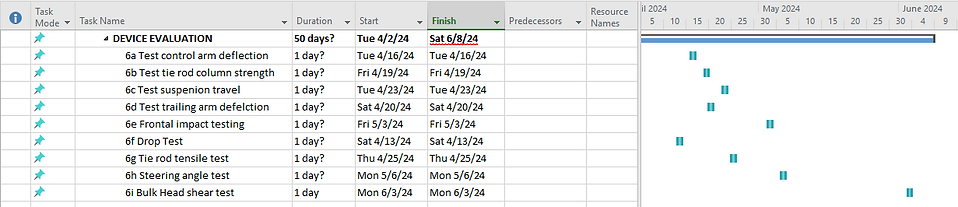
The engineering team that was responsible for designing and producing the RC car decided to break the project into three parts over fall, winter, and spring. Fall quarter (section 1-3 of Gantt chart) was design, and this encompassed 12 analyses, 12 detailed drawings, and completion of the proposal. Winter quarter (section 4-5 of Gantt chart) was construction quarter, this consisted of manufacturing parts and ultimately assembling the entire car. Spring quarter (section 6-7 of Gantt chart) was testing quarter, during this quarter the engineers ran tests on the car and its components. These tests ranged from tensile tests to impact tests and seemingly everything in between. During spring quarter the engineers also scheduled several deliverables. These deliverables consisted of presentations, competitions, and assignment submissions. Many factors impacted and put the schedule at risk. For example, when parts would take longer to arrive than originally estimated, assembly dates would be pushed back to accommodate the late parts. The engineers had a large impact on the schedule too, because sometimes tasks would just take way longer than originally expected and the engineers were required to push back their own dead lines. The following Gantt chart outlines the schedule that the engineer followed.
Gantt Chart:




Budget:
The budget for this project was $1,000 and the engineers planned to only use 85% of the budget. The funding was provided by the engineers and partially by family and friends. One of the major budget cost in the fall was the motor and ESC combo from castle creations which costed $170, and came with a 1515-2200kv motor and the mamba X ESC. Other costs in the fall consisted of batteries, transmitter and receiver, steering servo, tires, spindles, shocks, and a drive shaft for a total of $280. All together the cost for parts in the fall was $450. In the winter time some parts like the control arms and chassis were sent to "send cut send" to be manufactured, this cost totaled $50. Other small parts like fasteners, gears, and assorted hardware were purchased during winter and these small costs added up quick for a total of $150. The other $200 was used for purchasing materials to manufacture certain parts. For example, the tie rods and upper long arm required specific sizes of steel rods that the machine shop did not already have. The engineers estimated labor costs for the project at $37 per hour, however, the labor cost estimates did not actually affect the budget because the engineers were not paid.
Table B1- Total project budget
